
Publications
Latest
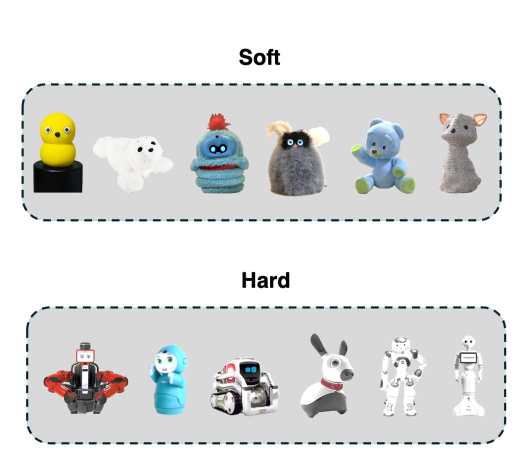

Teachers perceive distinct competencies profile in soft and hard social robots to support learning
Leisten, L. M., Caruana, N., Cross, E. (2025). International Conference on Robot and Human Interactive Communication.
We asked teachers how a robot’s exterior (hard plastic vs soft plush) influences their perceptions of its suitability for learning. We found that teachers viewed hard robots as more competent, intelligent, human-like, and better suited on taking roles as a teacher or tutor. As for soft robots, teachers viewed them as warm, cute, and better suited on taking roles as a support peer or novice co-learner. Despite this, we also challenge the assumption that hard complex robots are universally superior in education.
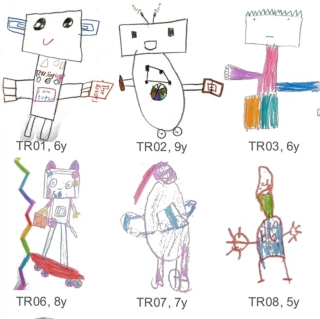
Children with and without reading difficulty value robot reading companions that are smart, supportive, and personalised
Moffat, R., Cahill, H., Cross, E. S. & Caruana, N. (2025). Scientific Reports 15.
We asked children (5-9 year olds) what they would want, expect, and value in a robot reading companion to help design future educational social robots. We categorised children’s desires across four core areas: reading-specific and emotional support, friendly companionship, academic intelligence across subjects, and bright, non-intimidating aesthetics.
The Impact of Shared Book Reading on Children and Families: A Study of Dolly Parton’s Imagination Library in Tamworth, Australia
Galea, C., Robidoux, S., Salins, A., Noble, C., & McArthur, G. (2024). Journal of Research in Childhood Education.
In this longitudinal study, we examined the impact of Dolly Parton’s Imagination Library, a program that delivers age-appropriate books to children from birth until their fifth birthday. Participation in the program significantly increased children’s reading frequency and duration, with early reading habits persisting strongly over three years. Additionally, frequent shared reading was directly associated with gains in literacy skills.
Pre-print
Pre-print paper title 1
Author (Year). Journal submission.
Blurb
Pre-print paper title 2
Author (Year). Journal submission.
Blurb
Previous
-
Dyslexia and mental health problems: introduction to the special issue.
Georgiou, G. K., Parrila, R., & McArthur, G. (2024)
-
Physiological correlates of anxiety in childhood and adolescence: A systematic review and meta‐analysis.
Ko, K., Jones, A., Francis, D., Robidoux, S., & McArthur, G. (2024)
-
Are comorbidities of poor reading related to elevated anxiety in children?
McArthur, G., Doust, A., Banales, E., Robidoux, S., & Kohnen, S. (2023)
-
Perceptions of intelligence & sentience shape children’s interactions with robot reading companions.
Caruana, N., Moffat, R., Miguel-Blanco, A., & Cross, E. S. (2023)
-
Talk, Listen and Keep Me Company: A Mixed Methods Analysis of Children’s Perspectives Towards Robot Reading Companions.
Caruana, N., Moffat, R., Miguel-Blanco, A., & Cross, E. S. (2022)
-
Are different reading problems associated with different anxiety types?
Francis, D. A., Hudson, J. L., Robidoux, S., & McArthur, G. M. (2022)
-
Tracking the relations between children’s reading and emotional health across time: Evidence from four large longitudinal studies.
McArthur, G., Badcock, N., Castles, A., & Robidoux, S. (2022)
-
Poor reading and anxiety (PRAX): Building a theory and practice.
McArthur, G. (2022)
-
Social/dialogical roles of social robots in supporting children’s learning of language and literacy—A review and analysis of innovative roles.
Rohlfing, K. J., Altvater-Mackensen, N., Caruana, N., Van den Berghe, R., Bruno, B., Tolksdorf, N. F., & Hanulíková, A. (2022)
-
The effect of an integrated reading and anxiety intervention for poor readers with anxiety.
Francis, D., Hudson, J. L., Kohnen, S., Mobach, L., & McArthur, G. M. (2021)
-
Self-concept in poor readers: A systematic review and meta-analysis.
McArthur, G. M., Filardi, N., Francis, D. A., Boyes, M. E., & Badcock, N. A. (2020)
-
The association between poor reading and internalising problems: A systematic review and meta-analysis
Francis, D. A., Caruana, N., Hudson, J. L., & McArthur, G. M. (2019)
-
No association between autistic traits and contextual influences on eye-movements during reading
Caruana, N., & Brock, J. (2014).